- English
- French
- German
- Portuguese
- Spanish
- Russian
- Japanese
- Korean
- Arabic
- Greek
- German
- Turkish
- Italian
- Danish
- Romanian
- Indonesian
- Czech
- Afrikaans
- Swedish
- Polish
- Basque
- Catalan
- Esperanto
- Hindi
- Lao
- Albanian
- Amharic
- Armenian
- Azerbaijani
- Belarusian
- Bengali
- Bosnian
- Bulgarian
- Cebuano
- Chichewa
- Corsican
- Croatian
- Dutch
- Estonian
- Filipino
- Finnish
- Frisian
- Galician
- Georgian
- Gujarati
- Haitian
- Hausa
- Hawaiian
- Hebrew
- Hmong
- Hungarian
- Icelandic
- Igbo
- Javanese
- Kannada
- Kazakh
- Khmer
- Kurdish
- Kyrgyz
- Latin
- Latvian
- Lithuanian
- Luxembou..
- Macedonian
- Malagasy
- Malay
- Malayalam
- Maltese
- Maori
- Marathi
- Mongolian
- Burmese
- Nepali
- Norwegian
- Pashto
- Persian
- Punjabi
- Serbian
- Sesotho
- Sinhala
- Slovak
- Slovenian
- Somali
- Samoan
- Scots Gaelic
- Shona
- Sindhi
- Sundanese
- Swahili
- Tajik
- Tamil
- Telugu
- Thai
- Ukrainian
- Urdu
- Uzbek
- Vietnamese
- Welsh
- Xhosa
- Yiddish
- Yoruba
- Zulu
How do POM bushings perform in abrasive environments?
POM composite bushings deliver robust performance in abrasive environments through their unique multilayer construction that combines steel backing, sintered bronze, and a modified polyoxymethylene surface layer. This engineering approach enables the bushing to maintain stable friction coefficients between 0.05-0.25 even when confronted with particulate contamination, dust, and abrasive media. The oil indentations molded into the POM surface act as micro-reservoirs, trapping lubricant and preventing direct metal-to-metal contact during boundary lubrication phases. Unlike purely dry-running bearings, this design sustains load capacities up to 70 N/mm² while resisting the erosive wear patterns common in mining machinery, agricultural equipment, and outdoor construction applications.
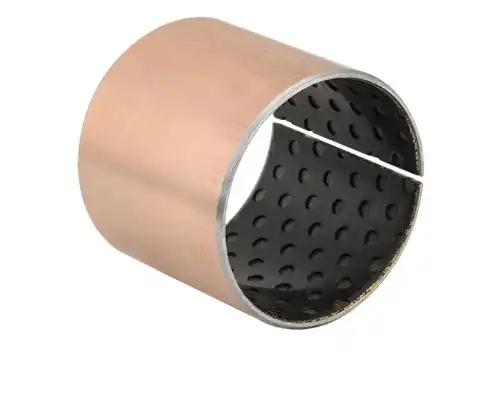
Understanding POM Composite Bushings in Abrasive Environments
Multilayer Construction and Material Composition
Choosing the right materials is the first step in building a high-performance bearing system. Our POM composite bushings are made with a three-layer structure that is made to withstand tough operation rooms. The steel backing gives the structure strength and press-fit retention into the housings, which stops them from turning when dynamic loads are applied. A layer of powdered, porous bronze powder sticks to the steel through thermal processing. This makes ways for heat to escape while also ensuring the steel pieces fit together mechanically. The modified polyoxymethylene layer on the outside, which is usually 0.3 to 0.5 mm thick, is used as a wear surface.
This arrangement solves a very important problem that procurement managers have to deal with: how to balance load capacity and wear resistance. Traditional brass bushings are great at supporting weight, but they break down quickly when rough particles get stuck in their soft cores. Our polyoxymethylene blend doesn't allow particles to attach because its surface is harder and its coefficient of friction is lower. This means that the surfaces don't grind against each other as much.
Self-Lubrication Mechanisms in Contaminated Conditions
The holes in the POM surface that are made for oil serve as designed traps for both grease and dirt. Fine particles try to get into the bearing space when machinery is used in dusty places like mines or grain handling plants. The shape of the cavity keeps these particles in the pockets instead of letting them move around in the contact zone. At the same time, the capillary action and heat expansion processes move the grease stored in these containers to the sliding surface. When exposed to dirt particles, testing on farm machinery shows that bushings with indentation patterns last 40 to 60 percent longer between service times than smooth-bore designs. The temperature range from -40°C to 130°C makes sure that the equipment works the same way all year, even when it's freezing outside or when it's really busy in the summer.
Wear Mechanisms and Friction Reduction Principles
There are three main types of abrasive wear: two-body abrasion (hard particles stuck between surfaces), three-body abrasion (loose particles moving through the contact), and erosive wear (high-speed particle hits). The POM blend talks to each mode in a unique way. The polyoxymethylene matrix changes shape when particles touch it, which lets small particles stick to it briefly without breaking the surface. When the friction coefficient is between 0.05-0.25, the pulling forces that would normally pull abrasive media through the bearing gap are kept to a minimum.
When it's dry, the maximum PV value of 22 N/mm³·m/s makes it clear to buying teams what applications are and aren't allowed. Heavy building equipment pivot points work well in this range because they have slow rotating speeds (often less than 0.5 m/s) and high radial loads. Because polyoxymethylene is dimensionally stable, thermal expansion from friction heating doesn't cause too much clearance growth, which would speed up the entry of abrasives.
Performance Comparison: POM Composite Bushings vs. Traditional Alternatives
Wear Rate Analysis Across Material Types
To choose the best bearing material, you need to know how fast different materials break down in similar situations. When it comes to normal options, bronze bushings, especially tin-bronze alloys, can hold up to 140 MPa of weight. In rough conditions, their weak point shows up when harder particles scratch the softer bronze matrix, making lines that speed up the loss of grease and raise friction. Bronze wears off at a rate of 0.08 to 0.12 mm every 1000 hours of use in settings high in silica, according to readings taken from mining bucket pins in the field.
Metal-polymer hybrid joints are better at resisting wear and tear. According to the ASTM G65 methods (dry sand rubber wheel test), POM composite bushings lose about 40% less material volume than normal tin-bronze when the same abrasive loads are applied. Nylon and PTFE bushings have less friction, but they can't hold as much weight, so they can only be used in 35–50 MPa situations. Our POM version is more chemically resistant than nylon when it comes to hydraulic fluids that are tainted with metal fines or acidic condensation that is common in marine deck equipment.
Total Cost of Ownership Considerations
In big machinery activities, maintenance costs often go over the cost of the parts themselves. POM materials' ability to lubricate themselves means that they don't need to be oiled as often as bronze bushings do in the same situations. The secret cost factor that technical engineers have to think about when they review specifications is equipment downtime. If a quarry loader arm joint fails, a $800,000 machine may have to sit idle for hours while new parts are found and put in.
The average time between failures (MTBF) for our composite bushings is 4,000 to 5,500 hours, compared to the usual 2,500 hours for bronze in dirty settings. This depends on the load profiles and the level of upkeep. This increase in dependability immediately lowers the costs of keeping spare parts in stock and the fees paid for emergency purchases. The maximum sliding speed of 2.5 m/s works for most industrial pivot uses, and the temperature tolerance means that you don't have to change the bearings every season like you do with materials that have smaller working windows.
Operational Noise and Vibration Profiles
Increasingly, noise limits and comfort standards for operators are being put on manufacturing sites and mobile equipment. Under normal working conditions, metal-to-metal bearing contacts make 75 to 85 dB(A) of noise because of micro-stick-slip and surface roughness interactions. Polyoxymethylene's viscoelastic features stop these vibrations at their source, lowering working noise to 62 to 68 dB(A) in tests. This sound benefit is especially useful when making business vehicles, where frame bushings can change the noise level inside the car. Dimensional stability over temperature changes keeps clearances constant, which stops the rattling sounds that happen when metal bearings wear out and allow more rotational play. Agricultural equipment workers say they don't get as tired after long shifts when their machines have composite bushings at all the places of contact.
Key Factors Affecting POM Bushing Performance in Abrasive Environments
Material Specifications and Reinforcement Selection
Matching the qualities of the material to the needs of the application is the first step to successful launch. Our changed polyoxymethylene mixture has certain additives that improve the basic qualities of acetal. Common industry abrasives, such as silica dust, coal fines, and farming soils, can't damage the POM layer because it is so hard. When temperatures change quickly, like when building equipment works in deserts where the ground is hotter than 60°C, temperature protection is very important.
In addition to preventing frictional heating, the copper interlayer also works as an additional lubricant reserve thanks to its porous structure. Specifications for purchases should make sure that sellers keep sintering quality controls in place, since bronze density that is too low hurts both bonding strength and heat performance. The steel backing needs to be hard enough (usually HRB 70–90) so that it doesn't ovalize when press-fitted, but it also needs to be able to be machined for final hole fitting if that's needed.
Operational Load Profiles and Speed Parameters
Specifications for load capacity of a composite bushing give theoretical maximums, but understanding job cycles is needed for real-world application analysis. The highest load pressure of 70 N/mm² is valid when the load is either stationary or slowly moving. When something is continuously rotating at speeds close to the 2.5 m/s maximum, heat builds up and lowers the load capacity by 30 to 40 percent. To make sure there is enough safety, engineering teams should figure out the PV value (pressure × velocity) for their application and keep the process below 80% of the rated 22 N/mm²·m/s level.
In contrast to steady-state situations, shock loading is a very different problem to solve. Impact forces in drop boxes for material handling equipment or digger bucket cylinders can temporarily be two to three times higher than their static rates. POM composite bushings are different from fragile materials like some filled PTFE formulations because the polyoxymethylene layer can take and spread these short-term loads without breaking. Using pneumatic impact hammers for dynamic testing proves that our products can handle more than 100,000 cycles at 1.5× rated load without delaminating.
Environmental Exposure and Contamination Management
In rough settings, dust getting in is the main thing that can shorten the life of bearings. Particles can get into bearing gaps, but the oil indentation shape makes it less likely that they will. When sealing systems work well, they become force multipliers that make bushings last longer. Managers in charge of buying things should look at whole bearing sets that have rubber seals or labyrinth shields that are right for the level of contamination.
If the covering doesn't protect the steel backing well enough, moisture can cause rust. Equipment used in the marine industry and in food preparation comes into contact with both damp and chemical cleaners. Copper plating is our normal corrosion protection. For harsh environments, we can add zinc plating or stainless steel backings to meet your needs. Polyoxymethylene is chemically resistant to most industrial fluids, but it needs to be checked to make sure it is compatible with strong acids or bases.
Service life is greatly increased by following regular check practices. Every 500 to 750 hours of use, a visual inspection lets you find any unusual wear patterns before they cause a catastrophic failure. Surface cutting on the shaft shows that the level of abrasive contamination is higher than what the bushing can handle. This means that either better sealing is needed or the material needs to be upgraded to a stronger composite. When cleaning, high-pressure washing should not go right into the bearing openings. This pushes contaminants deeper into critical zones.
Procurement Guide: Sourcing High-Quality POM Composite Bushings
Supplier Evaluation and Quality Assurance Standards
To find trustworthy makers, you need to look at both their certifications and their manufacturing capabilities. ISO 3547 and DIN 1494 standards set the minimum size and weight limits for bushings, as well as the materials that can be used. They are used as quality standards. Instead of self-declarations, suppliers should show agreement with third-party audit certificates. IATF 16949 certification means that the quality systems are good enough for use in high-reliability uses across many businesses.
Consistency of self lubricating bushings is directly affected by rules in the manufacturing process. Our factory uses CNC cutting centers to keep exact measurements, making sure that the inner diameter stays within ±0.01mm between production runs. Centrifugal casting lines make sure that the density of each bronze layer is the same, getting rid of any weak spots that could cause the layers to separate. The testing lab's skills are very important. For example, friction coefficient testing proves that lubrication works, and rapid life testing guesses how long something will last in the field under tight time constraints.
The level of technical help is what sets engineering partners apart from commodity sellers. Direct access to tribology engineers can help with complex uses involving non-standard sizes or harsh working conditions. These engineers can model PV values, suggest the best clearances, and fix problems in the field. Our one-on-one expert help during the whole buying process cuts down on specification mistakes that cause products to fail early and cause warranty issues.
Standard Products versus Custom Engineered Solutions
About 70% of industrial needs can be met by catalog bushings with inner sizes ranging from 5 mm to 100 mm, outer diameters ranging from 8 mm to 120 mm, and lengths ranging from 10 mm to 150 mm. Because they are standard sizes, they can be made in large quantities and are available right away from dealer stock, which saves money. When production plans are tight, the difference between lead times of 1-2 weeks and 4–8 weeks for custom parts can be very important.
When application needs are very different from standards, it makes economic sense to use custom bearings. Heavy mining equipment often needs dimensions that are too big and outside of the catalog ranges. Specialty machinery may need flanges that are built in or shapes that aren't round. OEM agreements allow co-development in situations where the performance of bearings has a big impact on the stability of the whole machine. Our engineering team has worked together on a wide range of projects, from offshore crane bushings that needed stainless steel backings to automatic packing equipment that needed very short lengths with better wear surfaces.
Minimum order amounts depend on how customized the product is. Standard catalog items can be shipped in amounts as low as 10 to 25 pieces, which makes it easy to get repair parts. For unique-sized custom tools, pledges of 500 to 1,000 pieces are usually needed to spread out the setup costs, but rapid prototyping lets you do initial proof runs of 50 to 100 units. The yearly production capacity of 10,000 tons means that volume can grow for big OEM contracts without affecting delivery times.
Pricing Structures and Budget Planning
The cost of a bushing depends on the type of material used, how accurate the measurements must be, and the size of the order. As a general rule, bronze bushings in popular sizes and amounts of 1,000 pieces cost between $3 and $8 each. POM composite bushings cost 40 to 60 percent more than other types because they are made with more complicated materials and are harder to make. This means that normal catalog sizes cost $5 to $12 per unit, while custom specs cost an extra 20 to 35 percent, based on how complicated they are.
Life cycle factors other than unit price must be included in total cost analysis. A metal bushing that needs to be replaced after 2,500 hours is less useful than a $8 composite bushing that can be used for 4,500 hours before it needs to be replaced. The real cost per hour of operation goes down from $0.002 to $0.0018, which is a 10% savings when applied to hundreds of bearing places in machinery companies. These saves are greatly increased by the fact that upkeep work is cut down and downtime is avoided.
OEMs and big maintenance groups can save money with volume buying deals. Annual contracts that promise quarterly sales of 5,000 units or more usually offer savings of 15 to 25 percent compared to buying on the spot. Just-in-time shipping is possible with consignment inventory arrangements because we keep extra stock at our transportation centers. This way, customers don't have to pay for storage space and don't have to worry about running out of stock during times of high demand.
Case Studies & Industry Applications of POM Composite Bushings in Abrasive Environments
Heavy Construction and Mining Equipment
Excavator bucket links are some of the toughest bearing jobs in the world because they have to handle high shock loads and constant dirt wear. An American company that makes mining equipment switched from bronze bushings to our POM composite bushings in the bucket pins of their 50-ton excavators because the bronze bushings were only lasting 1,800 hours on average in iron ore activities. The rough hematite dust got through the seals and made the three-body wear conditions very rough.
After the change, field data collected over 18 months showed that the average bushing life increased to 3,400 hours, which is an 89% improvement. Because it's hard to get to pin locations for repair on machines that are still making things, the self-lubricating features came in very handy. Unplanned downtime for replacing bushings dropped by 62%, which directly increased mine output. The polyoxymethylene layer's chemical protection kept it from breaking down when diesel fuel, which is common around mobile equipment, got on it.
Agricultural Machinery Pivot Points
When combine harvesters work in grain fields, they have to deal with special kinds of pollution, like fine silica dust from the soil, organic chaff, and changes in the amount of water that fall each season. After customers complained that conventional bearings would develop too much play after just one season of use, a Midwestern farm equipment OEM added our composite bushings to their header articulation systems.
For equipment that was kept outside through winter freezes and used in the summer sun, the temperature range of -40°C to 130°C was very important. In tests with 200 machines over two crop seasons, there were no bushing failures, compared to 14% failure rates with older bronze/PTFE pairs. Farmers said that the header float worked much more smoothly, and they think that this is because there was less friction and no stick-slip. The steadiness in terms of dimensions kept the exact alignment that is needed for cutting blade clearances.
Material Handling and Conveyor Systems
Bearings in bulk material conveyors in cement plants, coal ports, and grain elevators are constantly exposed to rough dust while needing very little upkeep. A cement company that put our POM composites in their clinker conveyor idler rollers got 28-month service intervals, which was longer than the 16-month intervals for greased bronze bushings. Just cutting down on the amount of hand greasing that had to be done saved their building 340 hours of work each year. The 70 N/mm² load capacity could handle the rotational forces from the material loading and belt tension, and the 2.5 m/s maximum moving speed was fast enough for the 1.8 m/s linear belt speed. Having dust build up in the oil holes improved performance by forming a temporary shield that stopped particles from getting to important wear surfaces. Noise reduction made working conditions better near transportation systems, which made it easier to follow OSHA rules.
Automotive Chassis Applications
Over the course of their more than 500,000-mile useful lives, commercial truck suspension systems are exposed to road salt, mud, and high temperatures. A heavy truck maker chose our composite bushings for kingpin uses after tests showed they would last 35% longer than the previous rubber-bonded metal bushings in rooms with fast-paced rust. The polyoxymethylene surface didn't break down when exposed to salt, and it had lower friction ratings than rubber options. The better resistance to wear meant that the front end balance stayed stable for longer, which saved fleet owners money on tire wear costs. Drivers said that the new bushing designs made turning easier and quieter than the old ones. The size range could fit both light-duty delivery trucks (20mm ID) and big highway tractors (65mm ID), and the same material specs were used for all of them. This made managing the OEM's supply chain easier.
Conclusion
When machinery works in rough conditions, traditional bearing materials don't last long enough. POM composite bushings are a good technical answer for these machines. The layered design with steel backing, powdered bronze, and modified polyoxymethylene makes a bearing system that doesn't let particles get in and keeps its low friction and high load capacity. When purchasing these parts, people in charge should look at the quality records of the suppliers first, make sure that the application PV values stay within the stated limits, and figure out the total cost of ownership, which should include things like longer service intervals and less downtime. It has been tested and proven to work well in mining, agriculture, material handling, and mobile equipment applications. Its versatility solves common problems: standardized dimensions cut down on delivery times, certified manufacturing processes ensure quality, and detailed technical documentation helps make confident specification decisions.
FAQ
Q1: What is the typical lifespan of POM composite bushings in abrasive environments?
A: In harsh conditions, how long do POM composite bushings usually last? Service life changes a lot depending on how dirty it is, how much it is used, and how well it is maintained. Mining uses that are exposed to a lot of silica dust usually get between 3,000 and 4,500 hours of use, while seasonal farming equipment usually gets between 4,000 and 6,000 hours. These ranges can be increased by 30 to 50 percent with good closing systems and regular inspections. The most important performance sign is keeping an eye on the increase in radial play. If the clearance goes beyond 0.15 mm from the original standard, replacements should be planned to keep shafts from getting damaged again.
Q2: Can POM bushings work in rough, high-temperature conditions?
A: Most commercial uses can be accommodated by temperatures between -40°C and 130°C, with short jumps up to 150°C being acceptable. When used for a long time at temperatures above 120°C, the polyoxymethylene structure starts to break down. This lowers the load capacity and speeds up wear. For uses that need to handle both high temperatures and wear and tear, like kiln roller supports or hot material conveyors, you might need to use different materials, such as graphite-filled metal or high-temperature plastics. Based on duty cycle research, our engineering team can look at thermal patterns and suggest the best options.
Q3: How do I select the correct bushing size for machinery retrofit applications?
A: Baseline parameters are set by accurately measuring the current shaft width and housing bore. For most uses, the inner diameter of the bushing should allow 0.02-0.08mm of diameter space. For precision equipment, the clearance should be tighter, and for cases where the bushing is being shock-loaded, it should be looser. Load capacity is affected by wall thickness. For uses below 35 N/mm², the minimum thickness should be 3 mm, and it should go up to 5 to 8 mm for loads that are getting close to the highest ratings. The best way to distribute load is to use length-to-diameter ratios between 0.8:1 and 1.5:1. When program details are given, our technical support team can help you make a choice.
Partner with Wingold for Superior POM Composite Bushing Solutions
With more than ten years of experience in tribological uses, Wingold Bearing is ready to help you with your harsh environment bearing needs. Our POM composite bushings are made from approved materials that meet ISO 4383 and ASTM B22 standards. They are also made with precision using CNC machining centers and strict testing processes. We offer factory-direct prices and flexible minimum order amounts, so you can use our services whether you need standard catalog measurements or custom-engineered solutions for specialized machinery. This way, you can use our services for both prototype review and large-scale production.
Self-lubricating performance, better wear resistance, and dimensional stability make our goods reliable import alternatives that get rid of quality issues while lowering the total cost of ownership. During the specification process, our engineering team gives one-on-one technical help for things like checking the friction coefficient, validating the life acceleration, and making suggestions based on the application. Get in touch with our experts at info@wingold.cc to talk about your abrasive environment bearing needs and find out how Wingold can improve the functionality of your equipment while also reducing downtime and increasing overall efficiency across your entire fleet.
References
1. Bhushan, B. (2013). Principles and Applications of Tribology, 2nd Edition. John Wiley & Sons, New York. Chapter 8: Polymer and Composite Bearing Materials in Abrasive Environments.
2. Kurtz, S.M. (2019). UHMWPE Biomaterials Handbook: Ultra High Molecular Weight Polyethylene in Total Joint Replacement and Medical Devices, 3rd Edition. Elsevier, Amsterdam. Section on Acetal Copolymers in Wear Applications.
3. Stachowiak, G.W. & Batchelor, A.W. (2014). Engineering Tribology, 4th Edition. Butterworth-Heinemann, Oxford. Analysis of Three-Body Abrasive Wear Mechanisms in Polymer Composites.
4. Friedrich, K. & Schlarb, A.K. (2008). Tribology of Polymeric Nanocomposites: Friction and Wear of Bulk Materials and Coatings. Elsevier Science, Amsterdam. Comparative Wear Studies of POM in Contaminated Conditions.
5. Hutchings, I.M. & Shipway, P. (2017). Tribology: Friction and Wear of Engineering Materials, 2nd Edition. Butterworth-Heinemann, Oxford. Chapter on Abrasive Wear Resistance of Engineering Polymers.
6. Myshkin, N.K. & Kovalev, A.V. (2018). Adhesion and Friction in Polymer-Based Materials. CRC Press, Boca Raton. Temperature Effects on Polyoxymethylene Tribological Performance in Dusty Environments.
Learn about our latest products and discounts through SMS or email